OOPS. Your Flash player is missing or outdated.Click here to update your player so you can see this content.

Today's news

Entrenamiento Cintos Negros - Septiembre 2010
There are no translations available.

Confirmamos el entrenamiento de cinturones negros el próximo sábado, 4 de septiembre. El entrenamiento se realizará en el Club Ichiban-Dojo en Murcia, a la hora de costumbre, de 17:00 h a 19:00 h.

Sensei Luis Nunes, IOGKF España


Aikido
There are no translations available.

Clases de Aikido. INICIO - SEPTIEMBRE 2010 (todos los niveles)

Read more text
 
Dejan de impartirse las clases matinales de los martes, jueves y sabados
There are no translations available.

A partir del mes de julio y hasta nuevo aviso, dejarán de impartirse las clases de las mañanas de los martes, jueves y sábados.

Read more text
 
Fotos Entrenamiento Playa Mar de Cristal 2010
There are no translations available.

A continuación mostramos algunas fotos del pasado 20 de junio, domingo, que corresponden a la sesión de entrenamiento convivencia en la playa "Mar de Cristal", que organizó IOGKF España como parte de la Actividad Fin de Temporada 2009/2010.

Read more text
 
Gasshuku 2010 IOGKF Italia con Sensei Luis Nunes
There are no translations available.

Por: Mimma Pietrucci – IOGKF Italy

Artículo de la Edición de Junio 2010 de la Newsletter IOGKF Internacional, traducido al español por Paco Salinas (Shodan Karate-Do Goju-Ryu y Webmaster IOGKF España)

Read more text

Search

Karate-Do The name "Goju-Ryu"
The name "Goju-Ryu" Print E-mail

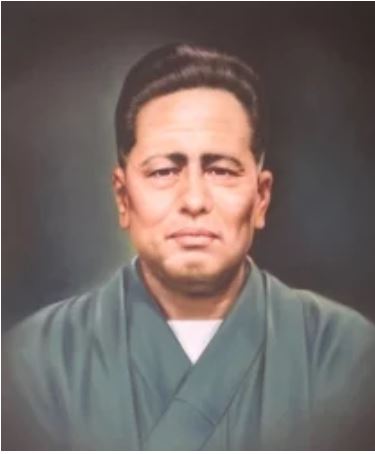
The oldest student of Miyagi Chojun Sensei, Shinzato Jin'an Sensei, once offered a kata exhibition at the tournament of every Japanese martial art. It was presented as part of the Hirohito coronation ceremony in 1930. After the exhibition, a kobudo master (traditional martial arts) asked Shinzato Sensei which karate school he belonged to. Shinzato Sensei was unable to answer the question due to the fact that there was no need for a name for each style of karate at the time. When Sensei returned to Okinawa, he told Miyagi Sensei of his encounter. Miyagi Sensei considered the problem for a time. Finally, he decided that it was necessary to give his style of martial arts a name in order to promote and spread it, as well as to cooperate with other schools of Japanese martial arts.

Jin'an

OUR STYLE

He called his art Goju-Ryu, which means 'hard and soft', following the eight laws of traditional Chinese Kempo, which can be found in the document titled “Bubishi”.

Bubishi

1. The mind is one with heaven and earth.

2. The circulatory rhythm of the body is similar to the cycle of the sun and the moon.

3. The way of inhaling and exhaling is hardness and softness.

4. Act in accordance with time and change.

5. Techniques will occur in the absence of conscious thought.

6. The feet must advance and retreat, separate and meet.

7. The eyes do not miss even the slightest change.

8. The ears listen well in all directions.

Bubishi

He was the first master at the various schools of karate to give his art a name. However, even though Miyagi Sensei gave his art the name of Goju-Ryu, he hardly ever used the name and did not put up any sign with the words Goju-Ryu in the dojo. In 1933, the art of Miyagi Sensei was officially registered as Goju-Ryu with the Butoku-kai, the association of Japanese martial arts.

The master Miyagi explained the reasons why he chose the name Goju-Ryu on several occasions. Although some people only know how to explain the relationship between the name and technical aspects of karate, such as hard and flexible techniques, Sensei Miyagi focused it on the development of human character. He sincerely believed that the karate student had to be physically hard, which is why practice sessions in his dojo were exhausting. Consequently, he would be able to mould the hardness of the body and mind, developing the strength of character and mental flexibility.

He insisted that each karate student had a responsibility in society. He considered that training in Goju-Ryu had to reflect every aspect of life. He believed that exhausting training sessions made students sensitive and gave them the capacity for judgement and a highly moral character that everyone should have.

The name of Goju-Ryu has often been compared with the bamboo tree: when it is young, it is strong and straight, but when the wind blows strong (and fighting against it could be fatal), it bends and returns to its original position when the wind disappears.

This form of control, flexible and effective survival impressed the master Miyagi and he used it as an example for overcoming the difficulties we encounter in life.

 
Banner